Tuesday, April 19, 2016

How Should I Prepare to Run My First 5K Race Ever?

Trainer Tuesdays

Welcome back to the weekly edition on Trainer Tuesdays. Make sure to check in at our blog every Tuesday evening to learn the expertise of our great staff of expert personal trainers. Aside from being fantastic exercise coaches, they are also extremely knowledgeable in many aspects of health and fitness; so, it's time that you get to know them a little better! Each week, we will post a frequently asked, or sometimes just a fun fitness related question followed by the answers of each of the personal trainers at Fitness Together Brecksville.


How Should I Prepare to Run my First 5K Race Ever? 

 
Fitness Together Brecksville owner Sean Sullivan and his wife Marion preparing to run a 5K 


Brooke Kratche: Hey! Open the door! It's okay, you don't have to worry about frost bite anymore (at least until next week). Now it's time to get outside and enjoy the weather. Whether you enjoy biking, hiking, swimming, running, or any other outdoor activities, it's time to get out there! For me, I love running, I love most outdoor activities but for right now let's talk about running. A good starting goal for new runners is a 5K. A 5K race is the shortest common distance race and is equal to 3.1 miles from start to finish. First thing you want to do is find a fun 5K to run. (Such as the FItness Together 5K in Youngstown) 5K races come in all different creative shapes from color runs to warrior dashes to glow runs with a concert waiting at the end. These fun twists will be a welcome distraction in the heat of the competition. 

Next we need to talk training. Start training for your first 5K about 6-8 weeks ahead of time. You should try and get 4-5 runs in per week with at least 1 cross training day (weights, swimming, biking, yoga, any exercise besides running) and 1 rest day. The first week should start with low distances, depending on your current endurance level. Try to run a mile without stopping then walk a quarter mile. Whatever your conditioning level is, keep pushing it. Your week should be structured with 2-3 short runs, 1 medium distance run, and 1 long run each week. The medium run should fall in the middle of the week (Tuesday or Wednesday) which is followed by cross training and the long run is at the end of the week always followed by your rest day. Keep pushing the envelope on your endurance and speed and vary your routes, speeds, and hills. This will force your body to keep adapting.
Two weeks before your 5K, your long run should be about 4 miles, just longer than your race. This is what is called peak week. It is the heaviest training week before your race.
The week before your race take it easy. Go on about 4 shorter runs at a decent pace. Leave the two days before your race to relax and make sure you are eating well. What you eat these two days will fuel you through the run. You may choose to run a quick 1 mile run the day before just to keep your legs loose but don't use too much energy. You want to be ready to go come the start on race day.

Lastly, we need to discuss race strategy. Since this is your first race you might feel a little lost in this sea of crazy people, most likely more than a few will be in full costume of some sort. Don't be intimidated, they are just there for the attention. You have trained hard for this day and you are confident in what you have already accomplished. Where you stand in the corral is important. Generally l, the people at the front of the gate will run between a 5 and 6 minutes pace for a 5K race and the people in the back are planning on walking. If you are running at an 8 minute to a 10 minutes pace find your way to the middle of the pack. Don't be afraid to ask around for other runners paces, they can give you a good idea for where you should be. It is important to be in a good place since being too far in front could kill your confidence as elite runners sprint past you and standing too far back will only lead to frustration as you try to weave around slower runners/walkers. But remember, have your goal time and stay on pace. Do not give into the adrenaline rush of the starting gun, it will come back to bite you as you reach the end of the race.  Most importantly, have fun! Take in the atmosphere, smile and interact with the fans lining the road, give high fives! These are the things that push you past fatigue and keep you coming back for more and more challenges.

Happy running!


Amanda Ricci: Preparing to run your first 5k ever is a new and exciting experience.  You should plan to train for the race for at least 8 weeks in advance to build endurance, strength and most importantly to avoid over-training.  If you do not take enough time to train for the race in advance you will not only put yourself at risk for over-training but also for injuries.  So the most important thing to do is to invest time into your training.  This will prevent your muscles from becoming over-taxed.  If you are serious about performing your best and doing well in the 5k but are confused about where to start Cardio Together program offered at Fitness Together can assist you in training for this race.  In preparation for the race, it is also important to make sure that you are nourishing yourself well and getting enough protein, vitamins and minerals.  This is also what is going to give you the best results in your upcoming race and help you perform your best.

Here is a calendar to break down the steps to prepare for your 5k:
1.       Two months prior to the race:  Start to prepare by running or walking. If you’re a beginner, it is important to start slowly, in order to build up your endurance.  As I stated earlier, this is going to prevent over-training, which can eventually lead to an injury.
2.       Prior to running your 5k, make sure that you have done some jogging or running before you begin.
3.       Night before: Make sure that you get enough rest.
4.       Race Morning:  Eat a healthy breakfast.
5.       Race Day:  Arrive at the race about 20 minutes early this will help to reduce anxiety and any stress. 
6.       During the race: Make sure you pace yourself.

Following these tips will ensure that you will get good results.  If you’re interested in continuing to run 5k’s and progressing towards running 10k’s, half marathon’s etc. it will also be beneficial to you to start a strength training program.  A strength training program would help you build muscle that will give your muscles more endurance to run and give you a faster PR time.


Adam Teplitz: Crossing the finish like of a 5k can be a life changing experience. Take these steps to properly prepare and train for a 5k:

1) Make a plan.  This can involve teaming up with a community of runners. Design a program that includes 20 minutes of walking initially, built up to running 30 minutes. Cardio Together is specifically designed to maximize your cardio routine and to achieve your specific goals.
Personal Trainer Adam Teplitz suggests finding shoes at a local running store
The combination of an enticing goal , a supportive group , and a specific program is all you need to tap into your inner runner.

2) Accessorize. Be sure to shop for the proper running shoes. Be prepared to try on several pairs. Staff should watch you walk and run in the shoes to make sure they work with your foot type. The shoes should feel comfortable. You can find the perfect pair of running shoes with help from the staff at Vertical Runner in Brecksville.

3) One step at a time.  Start from where you are, rather than where you want to be. Running too much too soon is the number one reason newbie runners quit. Begin with sprinkling in running, with mostly walking. This allows your body and mind time to adapt to the demands of running. It will also allow you to run a bit farther.
Always begin with a walking warm up. For the running portion of the workout, start with 30 seconds to one minute of running and follow with at least double the time power walking -1 to 3 minutes or until you catch your breath. Progress little by little, adding more running to the mix and less walking. Focus on going farther, not harder. Include no more than three runs per week and alternate run days with rest days or cross training activities (cycling, swimming, yoga.)

4) take time to recover. Recovery is just as important as training. The body grows stronger when you are resting.

Keep track, stay motivated and have fun. Track your progress along the way. Keep track of your running time, mileage and mood.
The more fun it is, the more you will want to do it again. Mix it up by taking a new route or running with a buddy.


Justin Traft: Clients that decide to run they're first 5k ever after losing weight or after
Personal Trainer Justin Traft mentions proper nutrition to fuel your run
reaching their fitness goals to prepare always ask for some pointers to prepare for a 5k. One would be make sure you are preparing yourself ahead of time. Doing training runs whatever that may be...for example: running a mile so many times per week then running say two miles on a certain day. Diet is huge-- you need to be fueling yourself with all the right nutrition. Carbs for those big day training runs. Hydrating is another big staple in training . You can't expect your body to perform at a high level of you aren't hydrating those muscle after and during. Third make sure you have the right footwear when training . A pair of shoes that contour to your feet . It's Always suggested to break them in before your big race to avoid blister on your feet and uncomfortable running.



MichaelRoberto: With warmer weather coming our way, marathons will slowly start popping up around neighborhoods and cities alike.  If you wish to participate in a 5k (3 mile) race, here are some tips.  First, focus of distance, not intensity.  Find a comfortable pace you can do, whether it is a fast walk of a light jog.  Next, aim to do more every time.  You might go 1 mile one day, then go a mile and a half the next.  Also prepare yourself by buying proper footwear with good cushioning.  Another good tip is to mentally psych yourself up.  Keep repeating to yourself "I can do this" or "this is nothing."  Keep telling yourself positive things to distract yourself from the race itself.  Finally make sure you are properly fueling yourself with a nutritional diet of lean protein, veggies, fruits and good carbohydrates. 


Steven Madden:  If you are getting ready for your first 5k, there are several things that can help. First, make sure you've got good shoes. If your feet are aching after the first five minutes, you'll never want to finish. Next, to train, start by walking. While you walk, run for thirty to sixty seconds, then go back to walking for at least double what you ran. Over time, increase the time you run and decrease the time you walk. Eventually, you'll be running continually. Lastly remember, that the race is only against yourself. So what if you are that last participant to finish, you still finished before everyone else who didn't even show up.


Lisa Clark: If you are thinking about running your first 5k race, the best place to start I recommend is your local running store to be fitted for some good quality running shoes. Taking care of your feet as a runner is key. Once you have the proper footwear, you want to start slowly. If you've never run before, one of the worst things you can do is hit the pavement running, so to speak!! Start out with a nice brisk walk for 20 to 30 minutes a few times before you even begin to run. Once you feel ready to start running its best to run in intervals, run at a nice steady pace for 30 seconds to a minute then slow down to a comfortable walk just long enough to catch your breath. Then pick up the pace and run again for another 30 seconds to a minute. Each time you go out (I recommend no more than 3x per week) try to push yourself to run a little further each time. Focus on the amount of time you are running, not how hard you are running! If you keep that up over several weeks, you will be able to increase your mileage and time to reach your goal before you know it!!


© 2016 Fitness Together, Inc. All Rights Reserved.   


Tuesday, April 5, 2016

How Many Times Per Week Do I Need to Exercise to See Results?


Trainer Tuesdays

Welcome back to the weekly edition on Trainer Tuesdays. Make sure to check in at our blog every Tuesday evening to learn the expertise of our great staff of expert personal trainers. Aside from being fantastic exercise coaches, they are also extremely knowledgeable in many aspects of health and fitness; so, it's time that you get to know them a little better! Each week, we will post a frequently asked, or sometimes just a fun fitness related question followed by the answers of each of the personal trainers at Fitness Together Brecksville.


How Many Times Per Week Do I Need to Exercise to See Results? 


Amanda Ricci: When trying to figure out how many days you should work out to see results first you have to think about your goal.  You need to be realistic with that goal and look at your schedule to decide how much time your willing to put forth each week in order to reach that goal.  Setting aside every single day for exercise is not realistic for many people.  Instead what you should focus on is the amount of time you spend working out.

 The American College of Sports medicine recommends that individuals work out at a minimum of 3 to 5 days per week.  If you are just looking to maintain your weight, meaning your not looking to lose or gain weight then workout at a minimum of 150 minutes per week (this is 30 minutes a day/5 days per week). If you want to start to loose weight and have more time in your schedule then it is necessary to work out between 200 to 300 minutes per week. 

Keep in mind that the more time you invest in yourself now the less out of pocket health care expenses you and your family will have to pay for later. If you do only have 3 days to work out then you could work out three days a week and work out for 1 hour and 10 minutes per day, which would total the 210 minutes necessary to progress yourself towards reaching your goal. Once you develop endurance you can begin to increase the intensity of your workouts to burn more calories during the time that you workout. Once you build that endurance and would like to work out less time you might be able to work out at higher intensities so that way you do not have to set so much time aside for working out in your schedule.  If you are committed towards reaching your goal it is necessary to add time to your workouts in order to add years on to your life.  You will be most successful toward reaching your goals by combining both healthy eating, strength training and cardio into your lifestyle.  All of these can be accomplished by coming to fitness together with our Nutrition Together, Personal training and Cardio Together programs.  This is what will help you to have a higher rate of success.


Justin Traft: So many of the clients ask what's a realistic number to shoot for when wondering how many days a week to train in order to see results. Well there are a couple of factors that go into that. First being that 3 to 4 days is realistic for most people. 5 days would be awesome, but not everyone can fully commit to that. Second would be nutrition-- what you eat. What's coming in and out of your body is the big key. You'll never achieve your true potential eating "Crap". I know this because I have been there. When I lost weight that meant I had to change my diet altogether… that's when I saw my body change for the good. Third, you need to make sure you’re doing cardio as well. This is in addition to the weight training. Luckily Fitness Togetherhas a customized cardio program that can be specially made for you to help you reach your goals. So many people ask ‘isn't that a lot to be doing cardio three times a week and training 3-4 times a week?’ and I always reply no! To make an impact and really change your body you have to dedicate time to allow it to change. One of my favorite quotes of all time "Things that are worthwhile were never meant to be easy".


Adam Teplitz: When it comes to exercise frequency, it all depends on what your goals are.
Whether you want to put on size, cut down and get lean , add strength, or just maintain , the amount of times per week that you train can be a direct correlate to your results. As a general baseline, if you're looking for any sort of results, I'd recommend that you spend at least three days strength training.

When the primary goal is fat loss and cutting, focus on doing 3 to 4 workouts per week. Fat loss workout programs should involve total body training , large movements , and a lot of energy expenditure to kick start the metabolism. You can a day of cardio in between the weight training sessions.

If you're primary goal is gaining muscle , look to increase your total weekly volume ( the amount of sets and reps .) One option is to split up the muscles that you train. One day can be dedicated towards chest and triceps, one for back and biceps, and one for shoulders and legs.
When strength is the primary goals , 4 days a week is ideal. Always remember to focus on the big 3 movements, squatting , dead lifting and benching.

No matter what your goals are, three days per week should be the minimum.

MichaelRoberto: Exercise can be an enriching and beneficial part of any life.  But for those wanting to achieve their goals super quick, I'm afraid it will take time and commitment.  If you want to see results from your training, you should exercise 6 times a week.  The way this works is that you should train with weights (dumbbells, barbells, etc.) at least 3-5 times a week to make your muscles grow.  It is also important to know that you should not strength train back to back.  you must allow a rest day in between training days to let your muscles repair and grow.  So on those those rest days, you can do some cardio, whether it is a light jog or just walking around the park, as long as you are moving.  One last thing: you should also take one day of full rest, relaxing and doing something you enjoy like reading or taking up a hobby.  


Steven Madden: Truthfully, to see results, you should be doing at least 20 min of cardio everyday. 30 would be ideal, but 20 will help get you there. Remember too, that it is in addition to everyday movement. If you walk to and from work everyday and it takes 40 min, understand that your body is used to it by now, and it needs more of a challenge. Don't stop walking to work, but you'll want to incorporate something else. Then you'll want at least three days a week of resistance training. By combining three days a week of resistance with everyday cardio, you will start to see the results that you want.


© 2016 Fitness Together, Inc. All Rights Reserved.   


Tuesday, March 29, 2016

What is a Good Workout For the Lower Back?

Trainer Tuesdays

Welcome back to the weekly edition on Trainer Tuesdays. Make sure to check in at our blog every Tuesday evening to learn the expertise of our great staff of expert personal trainers. Aside from being fantastic exercise coaches, they are also extremely knowledgeable in many aspects of health and fitness; so, it's time that you get to know them a little better! Each week, we will post a frequently asked, or sometimes just a fun fitness related question followed by the answers of each of the personal trainers at Fitness Together Brecksville.


What is a Good Workout For the Lower Back? 


Amanda Ricci: According to UNC School of medicine “Low back pain is the second most common cause of disability in the United States and a common reason for missing work.”  Back pain is common problem in the United States, and it can be caused by sitting too much as well as muscle imbalances and tightness. Carey and Freburger noted that “80 percent of Americans will experience low back pain at some time in their lives and the total costs of the condition are estimated at greater than $100 Billion annually, with two-thirds of that due to decreased wages and productivity.” (Freburger. Chronic low back pain on the rise: UNC study finds ‘alarming increase’ in prevalence, 9 Feb. 2009. Web.29 March 2016 www.med.unc.edu)  With that kind of expense to remedy lower back pain, it is important to not just find a quick fix, when trying to alleviate it.  Instead, we want that pain to dissipate permanently. Like any solution that works it may take time to strengthen that lower back. 
     
 When experiencing lower back pain it is important to incorporate exercises in your workout that do not place any pressure or stress on the lower back.  Some great exercises for the lower back include: Deadlifts, Good mornings, hyperextensions, partial crunches, single leg raises while lying on your back.  Exercises that you may want to avoid are: toe touches, leg raises, and full crunches.  If you are experiencing any back pain it is important to inform your personal trainer of this problem.  If there is any exercise that does aggravate your lower back tell your trainer so that they can first check your form to ensure that you are performing the exercise correctly.  They can also note any types of muscle imbalances that you might have and assist you in correcting them.  Therefore, since each individual may have muscle imbalances in different muscles your trainer is the best person to create a workout for you that will correct this. They also may be able to provide you with other tips to incorporate in your lifestyle on a daily basis that will help to take some pressure off your lower back.  When performing the exercises it can sometimes be difficult to translate the difference between discomfort or good pain, and even the bad pain.  While doing the exercises you should be prepared for your body to go through some changes and feel muscles working that you may have not used in a while.  This can sometimes feel awkward but this is why it is important to trust your trainer as well as perform the exercises with good form so that you can prevent injury. 
https://ssl.gstatic.com/ui/v1/icons/mail/images/cleardot.gif


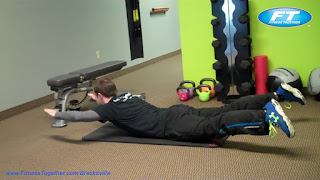
Fitness Together Personal Trainer Sean Sullivan demonstrating a Superman
Justin Traft: So everyone always asks what's a good lower back exercise. I have many favorites. First one that comes to mind is called Goodmornings--- great to help build up your lower back muscle strength. Another favorite of mine is stability ball back extensions or bench back extension. You can use a barbell plate or a dumbbell... even a medball. Another favorite: pulsing superman (or superwoman to be politically correct). Pulse for 15 reps then hold the contraction for another 15 seconds. Another favorite that hits a multi group of muscles is single leg deadlift with a dumbbell or kettle bell. Lastly one of my favorites in my current program is sumo deadlift wide stance. Make sure you take your time and go down all the way, then pull up slowly squeezing those muscles...even though your quads are the main group it still works the lower back too. So there are just a couple of my favorites forworking your ever-important lower back!


Adam Teplitz: One of the easiest parts of the body to injure is the lower back. To significantly lessen the chance of injuring your lower back , while increasing it's strength, consider incorporating these exercises into your strength training routine.

1) Hyper-Extensions
Lie face down with your stomach supported on a bench or stability ball. Anchor your feet. With your body straight , cross your arms in front of you or place them behind your head. Start to bend forward slowly at the waist , as far as you can go while keeping your back flat. Slowly raise back up to the initial position without rounding your back.

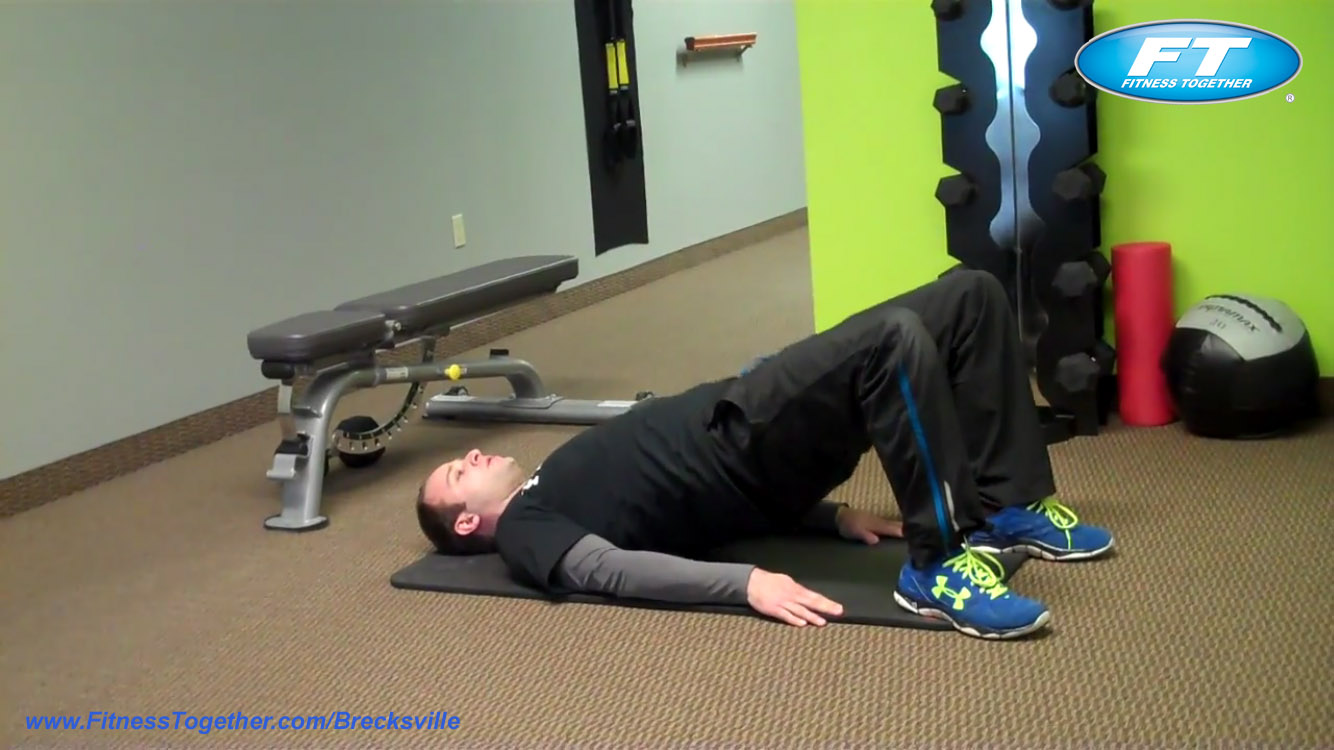
2) Bridge
personal trainer Sean Sullivan doing a Bridge

Start on your back with your knees bent and your feet about hip width apart. Drive your heels into the mat while you elevate your hips towards the ceiling. Complete reps or hold the position at the top.

3) Plank
This is perfect for people that suffer from lower back pain. The risk of injury is minimized due to your body being in a stable position. Start by placing your elbows directly under your shoulders. Elevate your hips , supporting your body only with your forearms and toes. Maintain a neutral spine throughout.

By consistently  incorporating these exercises into your routine, you will maintain a strong , lower back , which in turn, helps to maintain a strong overall core.

Brooke Kratche:  Working out your lower back is extremely important! It can help you avoid back pain but if you do them incorrectly, it can also lead to back pain. For that reason I will tell you the deadlifts and similar lifts will strengthen this area but I will not recommend doing them unless your trainer can show you correct form and assure you that you are doing them well.  Two exercise you can absolutely do on your own though are stability ball back raises and supermans. The first of the two involves resting your stomach on the stability ball and your feet on the ground. You'll want a wide base for balance purposes. Simply lift your torso up and down, bending at the hips. The second involves lying face down on the ground. Lift you thighs and feet off the ground as well as your shoulders, chest, and arms. Simply hold this pose for 30 seconds or pulse up and down! Mix it up and have fun!


Steven Madden: If you want to focus on your lower back, the whole deadlift family will help. Warming up with some Kettle Bell swings will get everything; including the lower back ready to move. Traditional deadlifts and Romanian Deadlifts will directly target the lower back, while Stiff-led Deadlift will recruit the lower back for support and stabilization. The Rack Pull is the Deadlift without the leg portion of the move, so you'll start right away with the back. Some Goodmornings will help you finish off your lower back.


© 2016 Fitness Together, Inc. All Rights Reserved.   


Tuesday, March 22, 2016

What is Your Favorite Cheat Meal, and How Do You Plan For It?

Trainer Tuesdays

Welcome back to the weekly edition on Trainer Tuesdays. Make sure to check in at our blog every Tuesday evening to learn the expertise of our great staff. Aside from being fantastic exercise coaches, they are also extremely knowledgeable in many aspects of health and fitness; so, it's time that you get to know them a little better! Each week, we will post a frequently asked, or sometimes just a fun fitness related question followed by the answers of each of the trainers at Fitness Together Brecksville.


What is Your Favorite Cheat Meal, and How Do You Plan For It? 


Adam Teplitz: Everyone loves a good cheat meal. My go to cheat meal would have to be a Swenson's cheeseburger, with a side of onion rings and a diet coke. Making the 40 minute drive to the original Swenson's in Akron has been a family tradition for years.

Preparation is key. I exercise before the meal for damage control. It could be 30 minutes of high intensity interval training or 45 minutes of intense strength training.
Numerous studies have shown that exercise before a meal can increase the respiratory quotient ( the measure of the mix of all fuels burned.)  They also show that preceding a meal with exercise can prevent a shift to carbohydrates being burned for fuel. In turn, more fat will be burned for energy.
It's important not to let a cheat meal discourage you. It can be used as a reward for the hard work you've been putting in. Just remember to minimize the effects by getting in an exercise session beforehand.


Steven Madden: I don't plan for a cheat meal per se. Deciding to workout extra for a cheat meal kind of misses the point of a cheat meal, and can lead to the problem of seeing it as a reward, rather than a cheat, a dangerous distinction to make. The only real way I plan my cheat meal is that it is on payday. My wife and I get some local Chinese food and sit and watch The Big Bang Theory on DVD. I just remind myself that it is cheating, not some kind of earned reward.


Brooke Kratche: If you even skimmed our blog last week you would see how important nutrition is to staying healthy.  That being said, eating a bit  unhealthy here and there won't kill you.  Good news right?! It is important, however that you do not make a habit out of it.  For me, I love chicken wings! Take me to Buffalo Wild Wings and I'll spend all afternoon with a bucket Asian Zing chicken wings.  I'll wear the evidence of it on my face and under my fingernails (it's an excellent place for a first date).  Chicken wings are not my diet though, they are a special treat for me.  Maybe it is a huge Ohio State game or day full of March Madness or simply a fun Sunday date but it is not a diet staple.  Cheat meals should be fun! Work hard all week long then go out with friends and make a fun outing your cheat meal.


Lisa Clark:  Everyone likes to engage in a meal that is out of this world delicious and far from nutritious. The key is to not make it an every day occurrence and to plan for it to avoid guilt feelings and weight gain. My favorite cheat meal is pizza, BBQ chicken pizza with bacon! I just plan to eat a few less calories at each meal and snack throughout the day to accommodate and I make sure I get in a good workout on that day! Don't ever skip meals or snacks in order to allow you to eat a large cheat meal. Doing so will actually have the opposite effect as your body will slow down its metabolism and then will take longer to burn that meal. 


Mike Roberto: My favorite cheat meal is pizza.  The way I plan my cheat meal is that I usually have a slice or three on days when I am not at the gym, usually on rest days.  That way, I feel rewarded after a tough week at the gym and keeps my diet in check by enjoying food I don't normally during the week.


© 2016 Fitness Together, Inc. All Rights Reserved.